Category: Uncategorized

  • It’s inevitable – I need to write about AI

    It’s inevitable – I need to write about AI

    And true to my habits, it’s going to be from a “is it just me” perspective.

    I recently decided to make use of Claude (on a free plan so far) to act as my business advisor, since my so-called transition from my former (still being?) consultant approach to more of a peer is stalling. Inspired by the explosion of AI agent postings in all feeds everywhere, I thought I should start to build my own team in order to start a marketing campaign or something similar, maybe at least get some momentum in daily marketing work.

    I got some advice that I didn’t like so much from the bot, since it required me structuring my archives in order to feed the agent with information about me so that we should be somewhat qualitative. I then turned my question over to more of what I am (or should be) and how to act. The prompt looks like this:

    “With the background I presented initially and the file I just uploaded, I need some help with ideation. I’m struggling with two huge questions: What do I want to do? What could be a market where my experiences are valuable and I would have a good chance to really stick out and “stick” with prospective customers and what value should I bring to them? I have so hard to change route from the old-school consultant that I have been and maybe not been good enough as. I also have an idea about putting together a team of diversely skilled AI agents in order to get some momentum in an ideation process, but I don’t know if it’s worth the costs and effort.”

    Now things started to turn in more interesting directions. To this text, I had attached my profile or CV in English, and Claude told me that I possibly undersold myself and we started to elaborate on this, putting the whole agent project aside for a while, since this wasn’t of importance right now.

    I got a couple of alternatives of how to present myself and I picked one with, stated by Claude, more niche and possible higher risk, but speaking to the “curious and analytically minded” (that understand what I actually offer?).

    I reasoned that it’s worth taking the risk of not being understood by all. The ones who do are probably more worthy to approach anyway. And since I gave Claude the link to my website, it was hard to avoid a rebuild in the direction we had been taken on this.

    So, the web page was radically rebuilt from my earlier radical rebuild, and it felt okay.

    The next step was to dig into my LinkedIn profile, where I recently made a shift towards being a facilitator. The business for facilitators has recently started to erode, since AI tools can do a good portion of the work facilitators have done until now (this can be a bit exaggerated since very many organizations are far behind the ones that strive for real digitalization, but one cannot shy away from it entirely).

    This is where I was forced to halt and think things over. I was in an earlier stage given a tagline and a text for the “about” section on LI, and I took the tagline and pasted it as it was, looked okay. Then I asked Claude to give me a new draft for the about section, looked okay and I pasted it. Those two elements are the ones that are there now at the time for writing this, but what came next?

    I got a recommendation to write a post about me describing my skills and add this to the “Featured section on my LI page”, and so I asked Claude to give me a draft (at this point I was so accustomed to Claude doing stuff for me so it felt just natural). But – it didn’t feel good. The post is here, as-is:

    Most organizational problems aren’t people problems

    When a team underperforms, the diagnosis is almost always the same: wrong people, bad attitude, poor leadership.

    It’s usually wrong.

    In 25 years of working inside organizations — defense, healthcare, manufacturing, retail tech — I’ve seen the same pattern repeat across sectors, sizes, and cultures. The people are capable. Often experienced. Frequently aware that something isn’t working.

    What’s broken is the design around them.

    Three structural flaws show up more than any others:

    Unclear mandate. The team doesn’t have a shared, explicit understanding of what they’re actually responsible for — and what they’re not. So they absorb work that isn’t theirs, fail to deliver what is, and gradually lose confidence in their own judgment.

    Uncontrolled intake. Work arrives from everywhere, in every form, with no triage. The team is perpetually reactive. Nothing gets finished properly because something more urgent always appears. The list grows. Meetings multiply.

    Invisible technical debt. Infrastructure, tools, and processes that nobody owns and nobody has a plan to maintain. Everyone knows it’s a problem. Nobody has the mandate — or the budget line — to fix it.

    None of these are HR problems. They’re design problems. And they won’t be solved by a team-building day, a new manager, or a strategy offsite.

    They’re solved by looking at the structure honestly, naming what’s broken, and building interventions that hold.

    That’s what a business architect does.

    If you recognize this situation — in your team, your organization, or somewhere you’ve been — I’d be interested to hear which of the three it was.

    I just felt that this is maybe not me anyway – this is an opinion coming from an engine that I have fed with possible exaggerations and descriptions of who I have wanted to be somewhere in time, but does it align with what I want to be nowadays? I honestly can’t tell and I haven’t been able to tell for the last three or so decades, so how could an AI that I have known for just a couple of days and given a thin slice of myself know? The text is valid for sure, but this is more of an alias I have strived for in a period of my life. I have also noticed the many solopreneurs out here present an identity they want to be while actually working lower in the value chains, and it’s kind of sad.

    This made me realize that building myself is a job I must do myself and I need to carve out the real me, what I want to do, and why. This is in a time when delivering advice as a service is so (possibly temporarily) disrupted and so many are both searching for solutions and so many searching for the next gig. Being authentic is the most important thing, but which authenticity should I choose? And in what way does this make me stand out from the crowd? There are a dime a dozen like me fighting for being seen, is it really meaningful, or should I continue experimenting with Claude and see how far it can go?
  • Me, an AI native business owner? Sure, why not

    Me, an AI native business owner? Sure, why not

    Or do I have any other options?

    My feeds suddenly started flooding with content about AI use recently — but all of a sudden on another, deeper level. Not sure what triggered it, but I think it was my interest in OpenClaw and the explosion of digital (AI) creativity that followed. After all, your feeds are always a result of your own earlier actions in them. Never forget that.

    My interest in AI development (or application) has been lukewarm, because I’ve had a hard time seeing the real game-changing benefits from my perspective. I’ve mostly been working with more or less sensitive information, in more or less regulated businesses, where public AI services simply aren’t viable options. I’ve also been a bit ambivalent because of the very polarized debate I continuously follow, mostly on LinkedIn. Should you join the enthusiasts or should you join the big tech critics? Both sides make more or less valid points, and it’s easy to just stay silent and watch.

    I’ve also been trying to understand the concept of AI agents and what they can actually do, but it never felt tangible in my professional context.

    A couple of months ago I attended a webinar where the theme was the importance of really going deeper into AI knowledge, demonstrated with practical examples. And once more I found myself thinking: “How can this be applied to my business? Not everyone can suddenly become a coder — nor should they, because there’s so much in the world that needs to be done or delivered that has nothing to do with coding. I’d better stay with my thing and try to do my very best in what I already do.”

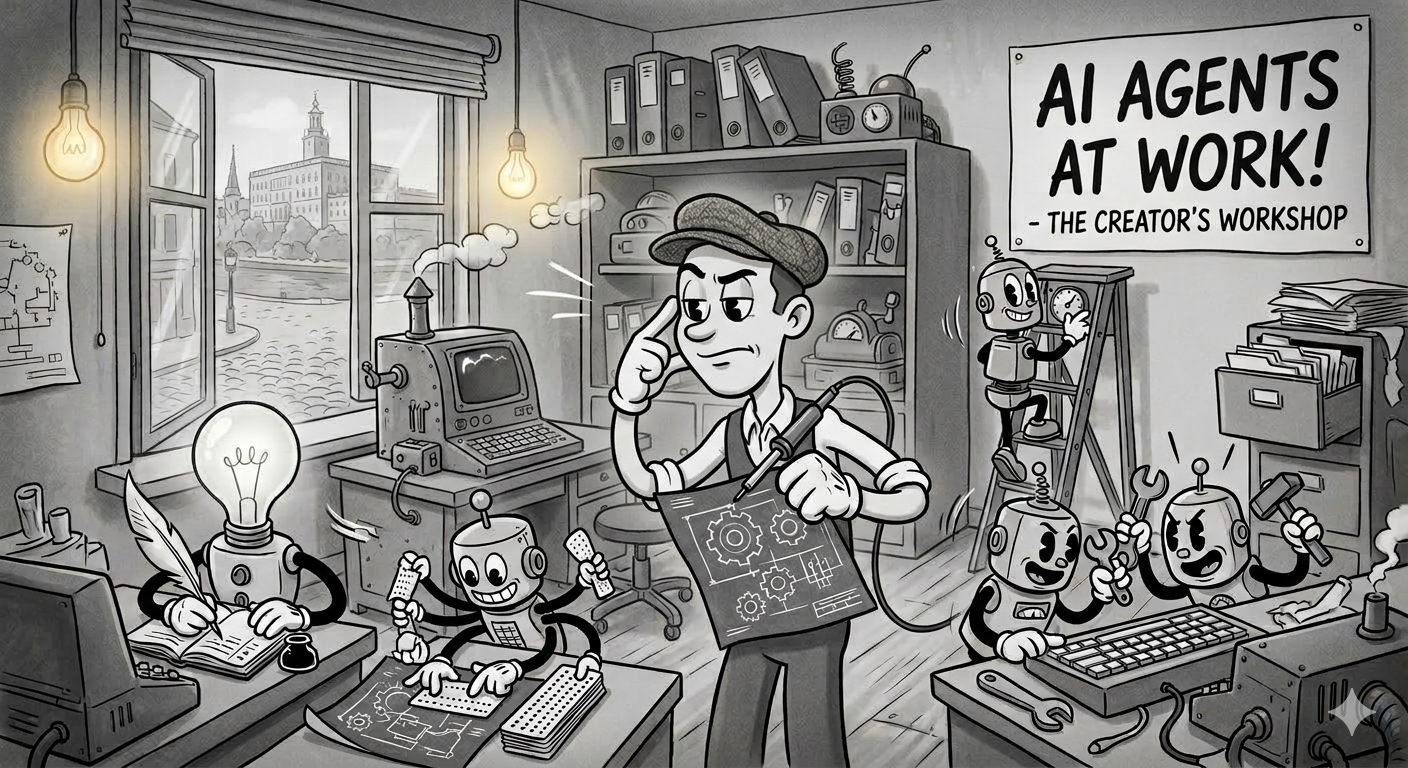
    And then it clicked. Not from a webinar this time, but from stumbling over some presentation covering the idea of building business teams based on AI agents.
    This turned everything upside down. The moment I understood that you could actually assemble resources — profiled and directed exactly the way you want — it opened the floodgates. I started generating ideas so fast my brain went into three-shift mode. Part of that is just who I am: unable to leave technically things alone, low fear of tinkering with IT, but also with enough of a grasp of technical design and security to know when something is actually solid versus just exciting. But even accounting for that — this felt different.

    Still, I can’t stop pondering what this means for the bigger picture. If a huge and fairly diverse part of the population suddenly starts building small, hyper-effective sales and service machines — what do markets actually look like then? To whom are we all going to sell? Will we flood all “human prospects” inboxes with cold emails in way that makes traditional marketing wreak havoc? And what really creates value in the future if everyone can spin up their own value creation, creating value for their own needs almost overnight?

    This applies mainly to service markets, of course. Houses still need to be built. People still need healthcare. Food still needs to be produced. But market mechanisms in the service space could, in a not-so-distant future, become subject to a pretty brutal overhaul (partly already ongoing, also known as “social media marketing”, er).

    And the direction of that overhaul? I genuinely don’t know. But I’m thinking about it a lot. Meanwhile I will start building my team, or maybe multiple teams…

  • Choosing language, the continued pivoting of me, myself, and more

    Choosing language, the continued pivoting of me, myself, and more

    Since I last posted, I’ve been struggling with my ”marketing overhaul” as part of my business model pivot. I actually haven’t been feeling very comfy about the path I chose, eg. trying to swiftly create some smart posts and articles on LinkedIn and start to send InMails on LinkedIn as well, to possible prospects.

    I actually got stuck in some sort of creative process I haven’t defined fully yet. Wondering where to go right now is possibly a part of the journey I’m on that should be to carve out “a strategy” if one prefers to use that term.

    I’m beginning to wonder if we shouldn’t treat “strategy work” as something deeper and more of an introspective thing, at least when it comes to what one as an individual needs to do in order to – well, there we are – in order to actually find a pace and a way of life one truly can enjoy. Enrolling in assignments with absurd conditions and expectations is neither fulfilling nor satisfactory in the long run. It might as well just be better and more comfortable to strive for – employment…

    What sparked my thinking in this possibly not-regarded-as-so-prosperous-and-successful-in-terms-of-monetization direction was a written piece of Maarten Dalmijn, a Dutch guy writing about, hmm, product management and value creation, I guess you can summarize it to. I’ve been following him from his earliest days of writing, and reading this essay was an enlightening moment for me.

    He writes so wisely about why easing the grip of climbing the career ladder when you really don’t need to, could be a better way for finding a better balance between work and life and everything in-between. I try to have in mind though that Maarten has a track record of maybe 10 years of writing on his subject, so he sure has an advantage – and that asset of making an impression is important to nurture.

    I have also reconsidered the change of language to use when writing and, hmm, marketing myself. I actually find it easier to express my thoughts in English, and there is a fact that I have preconditions for better reach with natively created texts in English. It’s a hard truth that Swedish is a niche language spoken by a few cave-living creatures up in the north… It also makes a web page much easier to maintain than having to implement multiple language support. So – I will re-translate my “marketing parts” on the web page again, but this time with a better clarity on who I am and what I want to deliver for potential customers (though the value proposition messaging actually has been remarkably consistent during the years).

    I will also try to cross-post as much as possible. I have decided that this site is my source and posts published here will show up, possibly slightly modified, on LinkedIn as articles and on Substack and I will try to evaluate where the best engagement is achieved, though the underlying drive force should be just to get everything out that is boiling in my head. 

    So, in order to follow the promised route about writing about strategy work, how it can be done effectively, and with myself as the example, here comes a first sentence:

    The first thing to do when deciding to actually dive into your strategy work is to perform a diagnosis. This is one of three pillars in what Richard P. Rumelt points out as “the kernel” of the strategy (I have adopted Rumelt’s theories about good strategy work that he describes in the book “Good Strategy, Bad Strategy,” and it is this “framework” I will promote onwards).

    Simplified, this first step is about asking oneself “what is going on?” And by this, identify the problem that is most prioritized to solve. For my own part, this is quite clear: I need to get some sort of cadence on my revenues again, and writing this is a small piece in the puzzle I’m about to solve.

    For the enterprise, be it small or big, this might be a tough start. And that’s where one like me can come in and make a difference. It’s important to bear in mind that I will get you to dig into your (and your organization’s) knowledge and lift your already made experiences up to the light so your business actually can benefit from knowledge hiding in people’s minds. With that said – I’m not the expert. You are. My expertise is in how to get you to release your (business’) potential.

  • Strategiarbete – ett aktuellt exempel –

    Strategiarbete – ett aktuellt exempel –

    Som ett led i att förklara vad strategiarbete kan vara tänkte jag ta mig själv som exempel.

    Ända sedan jag startade min egna konsultfirma har jag egentligen huvudsakligen gjort det som man gör som anställd i ett bolag eller organisation. Jag har svarat på annonserade förfrågningar med ansökan för att förhoppningsvis bli antagen på uppdrag som passar in på mina erfarenheter och förmågor, detta i konkurrens med fler – -> många andra som också bedömer sig som kvalificerade.

    Med tiden har vi blivit fler och fler som slåss om en kaka som i någon mån krymper och växer i takt med konjunktur- politiska- och andra omvärldsliga svängningar. Fundamentala marknadsekonomiska spelregler säger att med den spelplanen och avtagande fart på ekonomin sjunker priserna samtidigt som utsikterna att bli antagen (ytterligare) minskar.

    Det är i det här läget man är skyldig sig själv att fråga om det inte är dags att ändra på någonting – att börja jobba med sin strategi.

    Sagt och gjort: jag har dragit slutsatsen att jag borde gå från att vara en timdebiterande resurs till att vara en leverantör av bevisat värde (det går självklart att bevisa värdeskapande i timdebiteringsformen och skall så vara, men ofta tenderar värdeskapandet i den traditionella resurskonsultaffären att komma i skymundan av arbetet med att “fylla luckor”).

    Det jag levererar ska vara tydligt paketerat så man redan på förhand kan få en uppfattning om omfattning, kostnad och effekt.

    Som en följd av detta har jag behövt lära om och lära nytt – jag behöver börja sälja. och då menar jag sälja enligt den professionella definitionen av försäljning: att ge råd och rekommendationer som ger kunden ett bevisat värde.

    Utmaningen jag tagit mig an är så mycket mer omfattande än jag kunna göra mig en föreställning om och den skapar en mestadels obehaglig känsla av osäkerhet. Men kanske den osäkerheten i det långa loppet ger mer tillbaka än den falska säkerhet som en tillsvidareanställning, eller långa, svårjobbade uppdrag ger. Du vet ju aldrig på förhand när det plötsligt är dags att packa ihop och gå hem, och du får inte alltid reda på orsaken till varför det blir så.

    Här börjar min resa mot – tja, något annat än det tidigare i alla fall. Saker jag hittills gjort för att öka mina chanser att lyckas:

    • Gått en kurs i hur man bokar möten genom kalla samtal
    • Riktat upp en väldigt ostyrig hemsida som aldrig haft ett vettigt innehåll för att marknadsföra mig (här återstår MYCKET, men nu talar den i alla fall om vad jag gör (vill göra)).

    Vad som återstår:

    • Att lära mig grundläggande prospektering (ett mycket utmanande område)
      • Omsätta ovanstående i handling (d.v.s. identifiera målgrupper och därigenom s.k. suspects – förmodat intresserade av mitt erbjudande)
      • Skapa och bygga min hitlista, d.v.s. en lista över de personer jag tror är intressanta att kontakta
    • Att öka min närvaro på sociala medier, där LinkedIn är prioriterat
      • I detta lista ut hur algoritmerna jobbar för mig istället för tvärtom
      • Posta och framförallt interagera
    • PRIO 1 – men ändå inte – att börja ringa kalla samtal
      • Här behöver hitlistan vara framme
      • Sociala medier behöver kunna bekräfta bilden av mig (well, but…)
    • UNDER TIDEN: skapa koncept, beskrivningar och underlag för mina produkter.
      • Presentationer
      • Info på hemsidan
      • Material till sociala medier
    • ALLT ANNAT:
      • Tiden som jag behöver ta tillvara på ett ansvarsfullt sätt, mycket mer av min arbetstid är numera ”min tid” mot tidigare ”kundens tid”
      • Alla hjärnspöken som sitter på mina axlar och skriker i kör: ”DU KOMMER ATT MISSLYCKAS, DU ÄR INGEN, DU ÄR FÖR GAMMAL!” Och så vidare. De här behöver på riktigt hanteras med fast hand och en stor dos energi och envishet. Frågan är bara hur?

  • Vad är egentligen en strategi?

    Vad är egentligen en strategi?

    Ägnar du dig åt strategisk planering? Har du en strategi-plan? Då är det dags att tänka om. Varför då? Jo för att en strategi är något helt annat än en strategi-plan, även om man kan lista åtgärder och aktiviteter som behöver genomföras, med ansvarig och tid då det ska vara klart med mera. En strategi handlar oftast om en förflyttning från ett tillstånd (nuvarande) till ett annat (önskat). En strategi bygger på vilja, antaganden, visioner och mål och den rymmer osäkerheter man måste hantera under resan man gör.

    I företagssammanhang borde det handla om att göra något för att skaffa sig en fördel före medtävlare (konkurrenter), så att man säkerställer fortsatt eller ännu hellre ökad konkurrenskraft och därigenom ökad tillväxt.

    I en offentlig verksamhet borde det handla om att exempelvis förändra hur man lever upp till det som är ens uppdrag, där det överordnade syftet alltid bör (ska?) vara att tjäna medborgarna på bästa möjliga vis.

    Vad är nytt i det här då? Undrar du förstås – det här har vi ju hört så många gånger förr?

    Ja, det kanske låter konstigt, men de flesta företag och organisationer ägnar sig gärna åt ”strategisk planering” hellre än riktigt strategiarbete, för det är mycket bekvämare än alternativet, det man borde ägna sig åt på ledningsnivå.

    En av de bästa definitionerna av begreppet “strategi” har Roger Martin formulerat och den kan man ta del av här. Den lyder som följer:

    Strategi
    “En sammansatt uppsättning val som som placerar dig på en spelplan du väljer, på ett sätt som gör att du vinner”.

    Strategin har en teori: den förklarar varför du ska vara på den spelplanen du väljer, och vidare hur du, på denna spelplan, ska vara bättre än någon annan på att betjäna kunderna på den spelplanen. Den här teorin måste hänga samman i alla sina delar och den måste vara genomförbar. Du behöver kunna identifiera aktiviteter ur den för att det ska vara en bra strategi.

    Strategi

    • Verkliga kunder är kunderna
    • Du kan inte kontrollera dem
    • Du kan inte kontrollera intäkter

    Plan

    • Du kontrollerar kostnader
    • Du är kund
    • Det är vant och bekvämt

    Låter det här krångligt och abstrakt?

    Det finns metoder för att göra det här mer greppbart och enkelt att jobba med. Jag kommer att förklara hur i kommande poster.

  • If I told you that your documentation sucks, would you agree?

    If I told you that your documentation sucks, would you agree?

    The real challenge when discussing documentation quality is that it is a topic with so many layers, bottom and dimensions. But I can tell you the following: maintaining documentation is almost an impossible task, when talking about quality and conformity, if you don’t do it right.

    It’s also hard to sort out what one actually mean when talking about documentation. In my world, the most obvious type of documentation and actually where I should start a “sifting project” if I got the assignment to do it, is in what many often, quite nonchalantly calls the “operations management system” or maybe “business management system”.

    This is most commonly residing in a folder structure on an internal server and consists of a more or less large chunk of word and excel files. Some organizations are that bold so they actually buy a system or a service to use for this, but many, if not to say most, organizations rely heavily on an implementation of Sharepoint that someone purchased years ago, maybe a bit clueless about what to use it for.

    The really minor version of the business management system is the word file in the small company that the employees in an ideal world receives printed in their hand at their first day at work. In Sweden often called “företagshandbok” or “business handbook”. Here one should be able to take part of decisions made by the firm’s boss(es), that are general and not subject for change that often.

    But what happens when new or changed conditions arise, and new decisions are made that might make the printed statements obsolete and possibly even contradictory to what earlier has been communicated? This is a phenomenon valid for all and everybody, regardless of size of the organization or pace in information changes. I should say that in the very same moment that a new decision Is made, or a circumstance popped up making writings inaccurate, the risk for trust within the organization start to erode. It might not be a big issue at first, but if the maintainer och the information don’t swiftly inform everybody affected by the change that new information is available, the risk is that someone find out and take advantage of it. Within a shorter period of time one realize at first, the respect for what has been decided lessens, and so does the attitude towards personal responsibility and engagement as well. This will do daily management more cumbersome to perform and time for information maintenance will be taken for handling errors and corrective measures.

    “But this is obvious!” say the initiated reader – “why even bother take time to write about such things that are always ongoing??”
    Well, maybe just because this is always ongoing, in far too many places. This also hampers the communication efforts and erodes the value of communication not seldom critical for the business in question. In a little bit longer turn it affects the profitability (or in a public service, level of value creation and effective use of taxpayers money.

    So, how should one do to get around this problem? I’m convinced that managers on all levels need to be continuously fostered in how to communicate. Because the communication culture is so firmly connected to the accuracy of what is communicated. I dare to say that if you manage to make everybody aware of the natural law of information, stating that:

    If one don’t have information, it is not possible to take responsibility,
    but if one have information, it is not possible to not take responsibility.

    Add to this that the information must be accurate, and you have a solid starting point for your work with communication planning.

    An additional bonus to this is that if you nurture a communication and information aware culture, overbody involved will be interested in and prone to put requirements on correct information to be correctly communicated.

    And this, is one of the most overlooked things in organizations. Now and everywhere.

    Technical documentation, often managed within some sort of Configuration Management Process, is partly a bit different though related. I will come back on that one in a future post. As well as the hurdles with how to actually get the organization informed for real. And that’s even one more future post.

  • Web3 and all of my questions, #2

    Web3 and all of my questions, #2

    So I challenged myself to understand web3 a bit more in depth, described in the former post. I also felt a need to ponder a bit around the financial and/or business model parts. Please enjoy.

    Money or currency, in the meaning of being a representative for a certain value, is based on trust. If not trust for the actual currency can be reached, the value [of the currency] can’t be persistent. There is a reason that currency in the form we know and have defined it, is centralistic by nature since it is mostly structures in the form of regimes (nation states and central administrations) that has been (able to) guaranteeing the currency’s value by promising law and order, personal security and much more.

    We do have plenty of reasons to dive into history to see if there are traces of not centrally guaranteed currencies and to see what has been their trust attributes. Maybe I put this up on my todo list, but it feel like research best made by somebody with better knowledge in this

    What you need to manage in order to get DAO/Dapp adaption to broaden, stay and become a new norm
    Our current economic paradigm that is driving towards eternal growth, has also paved the way for centralistic and linear value creation for a very long time. The model of legal entities with limited liability as ownership model has the centralistic approach as a foundation: a possibly scattered association of owners put the entire responsibility for growth (=success) on one single role: the CEO, or Chief Executive Officer, if everything is done correctly according to the model. The owners are only to put requirements on return of the investment made.

    The limitation of liability in turn has its own limitations: the requirements are unavoidably to be formulated by the board, which is populated by the owners of the biggest shares of the company. This makes the owning more of a passive expectation (and belief or hope) on returns for the owners of small shares = less attractive from an impact possibility perspective. With all trust for success put on one role – the CEO – the risk for failure is bigger. On the other hand, with the right CEO in charge, the capability to achieve success increases largely.

    The conclusion is obvious: the centralistic nature och the Ltd company is unbalanced, which is its biggest strength as well as its weakness since the economic paradigm we have made the norm for centuries is based on growth of invested capital being the only thing that matters in the end.

    This is as I see it the biggest challenge for a DAO, at least as long as the DAO need to exist and justify its existence in a paradigm based on returns of investments.
    A fully decentralized DAO is also risking to be slowed down by the need for consensus, especially if the decisions to be made that are put in the ledger are on a very detailed and operative level. Here it is super important to find a decent balance between deciding and doing, so that momentum always is assured.

    Ways to keep DAO’s secured from intervention from big web2 enterprises is another area to explore since the web2 traditional entities have no interest in DAO’s if they don’t add on to capitalization of the web2 company in question. Ways to prevent web2 companies hijacking of DAO’s and Dapp’s and other web3 artefacts are essential as this is already ongoing.
    Reaching a critical mass of real web3 adoption in the real world is the only way to get things to happen and the ultimate questions to ask are:

    1. How should the incentives look like in order to get people to invest in web3 so that perseverance is reached as well as real competition to the traditional growth modell?
    2. How should web3 applications survive on their own means as long as the traditional growth model is the norm?
    3. How should an alternative economic model look like that can act as an alternative so attractive, that it in long term outperforms the traditional growth model, so the traditional growth model becomes obsolete? I have seen numbers around 70 years for a new economic model to replace an existent.

    There is an obvious risk that web3 becomes a vision entrapped in the large-scale enterprises of tech companies that harbor blockchain architecture in their cloud service infrastructure – would this then become a “real” decentralized architecture, or is it just web3 running on web2, and is this even a problem? I would say it can be.

    Maybe an alternative, decentralized-native infrastructure is the future. (One of) the big question(s) is how this will be payed for, and who would take the challenge, and risk, to invest in it?

  • I posted on Apples user forum for the first time – and got refused

    I posted on Apples user forum for the first time – and got refused

    Now this is a cry baby post – this is the feedback and my post text down below. I don’t think it was that bad

    Hi MrArne, 

    Thanks for participating in the Apple Support Community.

    We’ve removed your post How I solved MacOS Sonoma and the photos library sync dilemma because it contained either feedback or a feature request that was not constructive.

    To read our terms and conditions for using the Community site, see this page:  Apple Support Community  – Terms of Use

    We hope you’ll keep using our Support Community. You can find more information about participating here:  Apple Support Community – How To Articles

    If you have comments about any of our products, we welcome your feedback:  Apple – Feedback

    We’ve included a copy of your original post below.

    Thanks,

    Apple Support Community Staff

    My post text start here:

    N.B – this is not a question, it’s a proposition – not likable by all, but who am I to judge?

    To begin with – this should actually been written down here already, but my search attempts don’t find anything similar.

    I’m on a MBP M1 Max from mid -21.

    I started this computer fresh, no TM backup installed, since I endured the Catalina Hell on my old intel machine and solved these problems in the same way as now, with full success – like now.

    To clarify my prerequisites: I’m nowadays a blind optimist, relying on cloud storage instead of local storage and Time Machine backups, so I store all my files in a somewhat ordered (?) manner on iCloud (with a grotesquely big iCloud photo Library), OneDrive and Google workspace (paid version). Oops, forgot a small portion of Box.com and some residuals on Dropbox…

    So – the only thing to actually backup is the system. I have always been a proponent of backups, but I also realize that this is so much more complicated in order to really achieve a high and reliable quality level. Those of you who think I’m a moron may do so, I simply don’t care (until I need to realize that you were right anyway, by some obvious reason you are pointing out…).

    So, to the point:

    I copied all files I found too valuable and that was stored locally manually on an external disk. I then read in Apples support pages about how to perform a fresh (re-)install of Sonoma, which is much more easy now that it was before – nowadays a little more iOS-like ???? – you reach it from the settings menu

    After the fresh install I logged in on the computer, with my iCloud-account and all the iCloud-stuff was slowly synced to the computer. Now I have a fully functioning Photo Library – and I need to repeat these steps on my wife’s MBA M1…

    I know that this is quite crappy by Apple from a quality perspective, but it is what it is… at least there is a solution on this very annoying problem, and as so many times before I guess it’s all about file access issues, but who knows where?

    This is a send-only account. Replies received at this address are automatically deleted.

    Of course, I had some badly hidden critique against the quality of the software, but was it so bad? I will never waste my time on posting my findings there, and at least that is somewhat benficial experience.

    It is also interesting because for me it is a sign of the functional dumbness that most enterprises get more or less trapped in.

  • Everything is production, really

    Everything is production, really

    If I should summarize my work life so far, the common denominator for everything I have been in, made, or contributed to is

    Production

    How can that be?

    It might sound far fetched, but I can (actually) argue for this. If we look at value creation which could be another term to compete with production, I see that the process (or processes) that we draw to describe flow of value are similar – so similar so it’s more of a matter of self-identification that make you feel what sort of work you do – though I would say that you produce something in any case, because production without creation of value is non-existent (though some organizations surely do it, unfortunately).

    I will put up some theses to prove my point:

    1. Input and output (or outcome if you prefer to look at the bigger picture simultaneously)

    When we produce stuff, for instance in different industries, we need to put in raw material, instructions for how to treat these, and specifications for how we want the end result to look like.

    Value creation is more geared towards input of for instance customer needs, which isn’t necessarily tangible as some sort of hardware items – it could be totally immaterial. But there is an uncountable amount of needs through history that is fulfilled with some sort of tangible item.

    2. Resource assessment

    Both value creation and “pure production” can’t be performed without resources. The resources can be human’s time and skills, an AI prompt, machines and tools along a production line, software tools and platforms, code languages and so forth.
    Regardless of what you are about to accomplish, you need to assess what resources you need, how many you need (if the resource type is limited in it’s output per resource) and what pace you can expect from the setup you are planning.

    The exact same type of preparation is fundamental for creating value (though you rather shy for these dry and boring realities in the value creation context because value creation is something totally different and much more coomplicateed…)

    3. Manage and control (or orchestration and follow-up if you prefer)

    For production in the industry there is a lot of different and established, often branch-specific frameworks that is implemented quite well and also well taken care of, since product certifications, branch standards, CE markings and regulations require this.

    In the value creation realm things can be much less specified, depending on what type of business you’re in. It can of course be weighed down by really tough regulations and branch-specific requirements, whereas the value creation becomes constrained due to the circumstances and hopefully evaluated with that in mind.

    Finally

    To conclude this we can quite clearly see that value creation and production is just about same thing, different name.

    BUT – the value creation as a term always contains production, since folks working with production too often just see their own discipline as the almighty thing to do, where the need for customer focus, understanding and orientation etc, is overlooked.
    In these cases, there are a number of process owners and managers and so forth who constantly run around the production team and maintain customer focus for the ones refusing to adapt customer focus themselves. To defend the staff, many hardware work steps can be quite abstract to directly connect to a customer value, though they are unavoidably interconnected with an end result, which also is – an outcome.

    In for instance software businesses or IT-organizations on the other hand, we tend to push customer awareness and the need for creating customer values, not only outputs, onto the teams and resources directly. This is of course necessary and in fact fundamental in times of fierce competition and ever-evolving rapid development.
    The problem is that there are so many tasks necessary to perform, which are more of output nature and doesn’t fit in the outcome bubble since they are just secondary and more of enabling characteristics than direct wo-ho effects for the end user.
    Yet a lot, if not the most, in the immaterial producing business is about the same repetitive tasks that need to be performed, over and over again, without deviations – just like in any sort of industry… at least when we are looking at operations, which most often is overlooked since development is so much more fun to discuss.

    Meta-reflections:

    If we regard production as a subordinated process residing within a value creation – value, framework, wrapping, don’t really know what to call this entity – then marketing and sales also are subordinated processes residing alongside the production process. These are kind of production processes as well, where marketing’s output should be an irresistible urge to buy, and sales refines interested, so called prospects or leads, into buying customers.

    And existing or won customers are in turn refined to come into retention state – room for another production process… is this maybe called CRM…?

  • Vad menar vi med digital transformation och vem angår det?

    Eller – Digitalisering för nybörjare

    Härom dagen flimrade det förbi ett informationsfragment om digital transformation (igen) som jag inte kunde låta bli att glutta lite närmare på (igen). Det var en delning av en promotion för Internetdagarna.se, där Telias VD förklarade vad begreppet står för. Jag kan absolut instämma i det hon säger, men det finns en hel del mer i det här som rätt många tenderar att missa. Det här kan bero på att det jag vill uppmärksamma inte är så glamoröst och lättsmält, det reser en mångfald av ytterligare frågor och kan ofta lämna den det drabbar ensam med sina funderingar och utan underlag för väl avvägda beslut. Vidare tycker jag ofta att den här typen av budskap ofta drabbas av att korten blandas ihop i det man vill förmedla. Men vem är jag att påstå det och vad är det egentligen jag menar?

    Jo så här då:
    Telia pratar å ena sidan om sin förändringsresa i en strävan att skapa en mer kundorienterad organisation, här boostad med införandet av begreppet “kundbesatthet”… (Jag blir lite illa till mods av tanken på att ha en leverantör som är besatt av mig som kund måste jag säga. Det räcker gott om de är tydliga, transparenta och motsvarar, eller ännu bättre överträffar mina förväntningar. Jag vill faktiskt bara ha tjänster som passar mina behov, är tillgängliga och prisvärda.) För att komma dit behöver de genomföra ett förändringsarbete, gott så, inte helt ovanligt i stora och mogna organisationer. Vidare pratas det om ett nytt sätt att tänka när det gäller att driva sin affär och möta sina kunder. Jag hoppas de prototypar flitigt och omarbetar det som inte fungerar, ety Telia torde fortfarande ha en hel hög med gamla kunder som bara vill kunna ringa 90 200 och få svar på sina frågor – för så har en ju alltid gjort, eller hur? Sen ordas det en del om att de ändrat sitt förhållningssätt till sociala medier. Det är ju faktiskt helt nödvändigt idag och där kan jag nog tycka att de lyckats ganska väl även om inledningen var trevande och snubblande för ett par år sedan.

    Till sist nämner Telia sitt sannolikt smärtsamma och omfattande arbete med att stöpa om kundtjänstarbetet parallellt med systembyten, både för kunder och internt stöd.

    Sammanfattningsvis är det intressant att se hur en betydande aktör på den digitala tjänstearenan ser på arbetet med digital transformation – alla delar omfattas och hela organisationen berörs, ingen nämnd och ingen glömd. Men är det så för alla?

    Jag dristar mig till att påstå att arbete med förbättring av kundorientering inte nödvändigtvis är en del av digitalt transformationsarbete, det borde vara ett obligatoriskt grundelement i att leda verksamhet som ska leverera värde till sina ägare. Att jobba med sitt tjänsteutbud för att skapa nya värden för nya och befintliga kunder kan innefattas av digital transformation – men det måste inte alltid gälla. Att exempelvis bygga hus och meka cyklar är fortfarande något som har betydande analogt inslag, däremot kan hur vi kommunicerar vår förmåga att göra det och hur vi når våra kunder (även kallat marknadsföring resp. hantering av försäljningskanaler) understödjas och förstärkas med digitala stödtjänster, liksom naturligtvis automatisering av genomförandet.

    Vad jag vill komma till är att för dig som ansvarar för att leverera mervärde till ägare gäller samma sak som alltid har gällt och alltid kommer att gälla, d.v.s. att noga tänka igenom varför en förändring är nödvändig och vem som tjänar på förändringen som planeras. Det är sällan man löser en vikande efterfrågan eller en utebliven tillväxt om man inte jobbar med själva värdeerbjudandet och förändrar eller vidareutvecklar det i första hand. Att ständigt bedöma affärsmodellens relevans borde alltid vara nr 1 för alla. Digitalisering utan tydlig vinsthemtagning ska helt enkelt inte beslutas, oavsett om det handlar om automatisering av egna arbetsflöden eller nya sätt att driva sin affär på, eller att skapa helt nya affärer.

    Däremot skulle fler kunna tänka i banor av att “göra helt annorlunda” för att skapa nya möjligheter för värdeskapande. Det har fortfarande inte nödvändigtvis alltid med digitalisering att göra, men den är en allt viktigare möjliggörare för värdeskapande som tidigare inte ens funnits.

    Exemplet Telia ovan är en leverantör som verkar på en marknad i extremt snabb utveckling. Många andra gör det också, men långt ifrån alla. Hos “alla de andra” finns det minst lika mycket stora och spännande utmaningar när det gäller innovation, digitalisering och förändring. Men de kan vara svårare att identifiera i det brus som råder, och lätta att förväxla med “gammaldags” lednings- och förbättringsarbete.